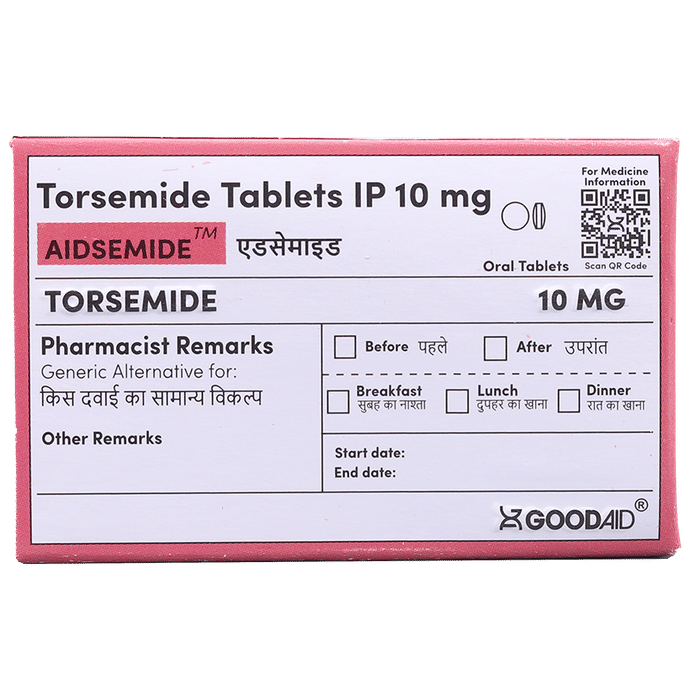
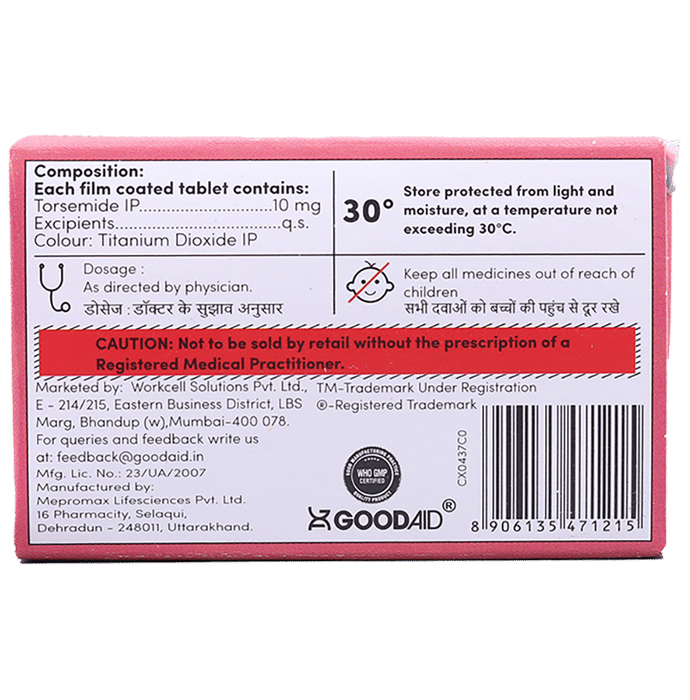
In Treatment of Edema Aidsemide Tablet works by increasing the amount of urine produced. This helps your body get rid of extra water thereby relieving symptoms such as shortness of breath and swelling in your arms, legs, or abdomen. This will help you go about your daily activities more easily and make you more confident about being active.
Take this medicine in the dose and duration as advised by your doctor. Swallow it as a whole. Do not chew, crush or break it. Aidsemide Tablet may be taken with or without food.
- Alcohol : CONSULT YOUR DOCTOR
It is not known whether it is safe to consume alcohol with Aidsemide Tablet. Please consult your doctor. | - Pregnancy : CONSULT YOUR DOCTOR
The safety of Aidsemide Tablet during pregnancy has not been established. There are no adequate and well-controlled studies in pregnant women, and animal data on reproductive toxicity are insufficient. Your doctor will weigh the benefits and any potential risks before prescribing. | - Breast feeding : CONSULT YOUR DOCTOR
Information regarding the use of Aidsemide Tablet during breastfeeding is not available. Please consult your doctor. | - Driving : UNSAFE
Aidsemide Tablet may decrease alertness, affect your vision, or make you feel sleepy and dizzy. Do not drive if these symptoms occur. | - Kidney : CAUTION
Aidsemide Tablet should be used with caution in patients with severe kidney disease. Dose adjustment may be needed. | - Liver : CAUTION
Aidsemide Tablet should be used with caution in patients with severe liver disease. Dose adjustment may be needed.
If you miss a dose of Aidsemide Tablet, take it as soon as possible. However, if it is almost time for your next dose, skip the missed dose and go back to your regular schedule. Do not double the dose.
Does Aidsemide Tablet raise blood sugar?::: Yes, Aidsemide Tablet may raise blood sugar levels, causing hyperglycemia. Hence, it is important to keep a track of your blood glucose levels during treatment with Aidsemide Tablet.| Does Aidsemide Tablet increase creatinine?::: Yes, Aidsemide Tablet may cause a mild increase in creatinine values depending on the dose you are taking. These increased creatinine levels may increase slightly more when this medicine is used for a long time. However, with discontinuation of the treatment, these levels return to their base value.| Does Aidsemide Tablet cause loss of potassium?::: Aidsemide Tablet may not cause direct potassium loss. But, in some cases, its use may cause excess loss of water, which may lead to dehydration. This, as a result, may cause loss of potassium, sodium, calcium, and magnesium.| My blood pressure is controlled now. Can I stop taking Aidsemide Tablet?::: Do not stop taking Aidsemide Tablet without talking to your doctor. Stopping the medicine may not overshoot your blood pressure levels, but may make your condition as it was before treatment. Therefore, discuss this with your doctor, who will advise you to change the medicine or the dosage as per your requirement.| How should Aidsemide Tablet be taken?::: Take Aidsemide Tablet exactly as advised by your doctor. Generally, it is recommended to take Aidsemide Tablet once daily, preferably at the same time each day. Aidsemide Tablet is known to cause excess urination, and hence it is advised to take it in the morning.| Is Aidsemide Tablet stronger than furosemide?::: Both Aidsemide Tablet and furosemide are almost similar in terms of safety and effectiveness. The only difference is that Aidsemide Tablet has a longer duration of action in comparison to furosemide, but the effect of both starts within an hour of intake.| How long does it take for Aidsemide Tablet to show its effects?::: Aidsemide Tablet starts acting within an hour of taking it orally, and its effect lasts for about 6-8 hours when given orally.
Aidsemide Tablet contains torsemide, a loop diuretic that works by blocking the reabsorption of sodium and chloride in the kidneys. This action increases urine production, helping the body eliminate excess salt and water. As a result, it reduces fluid buildup in tissues (edema) and decreases blood volume, which helps lower blood pressure and reduce the workload on the heart.
-Lithium carbonate (Oral Route): Severe
Watch out for symptoms such as impaired coordination, double vision, weakness, dizziness or confusion and consult your doctor if you experience them. Your doctor may monitor your Lithium carbonate and potassium levels frequently and adjust the dose of Lithium carbonate accordingly. Concurrent use may disturb the heart rhythm.
| -Tobramycin (Inhalation Route): Severe
Do not consume Tobramycin with Torasemide. If concurrent use is essential, your doctor may monitor your kidney function closely.
| -Amikacin (Injection Route): Moderate
If concurrent use is essential, your doctor may closely monitor your kidney's functioning and overall treatment. Concurrent use may increase the risk of hearing damage (ototoxicity) and kidney problems.
| -Chloroquine (Oral Route): Moderate
Your doctor may monitor your potassium levels closely. Concurrent use may disturb the heart rhythm.
| -Dexamethasone (Oral Route): Moderate
If concurrent use is essential, your doctor may monitor your potassium levels along with your overall treatment and adjust the doses as per the observations. Concurrent use may increase the risk of low blood potassium levels.