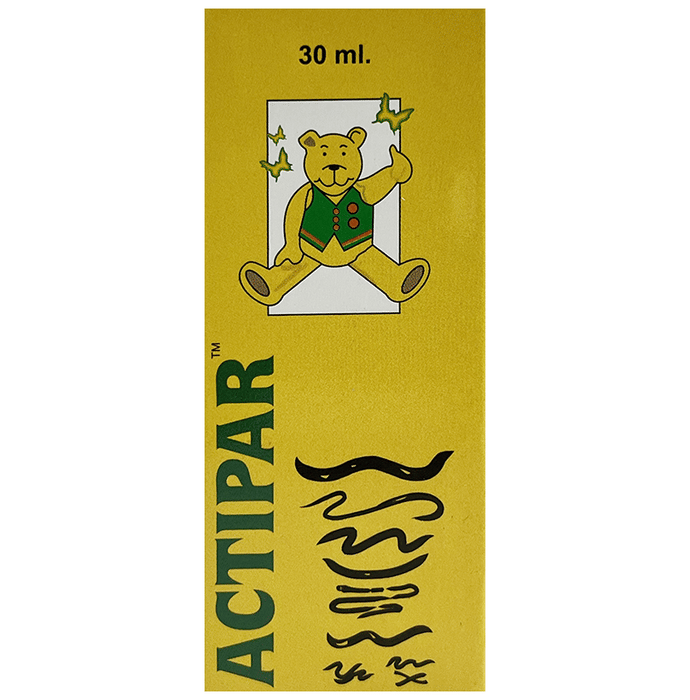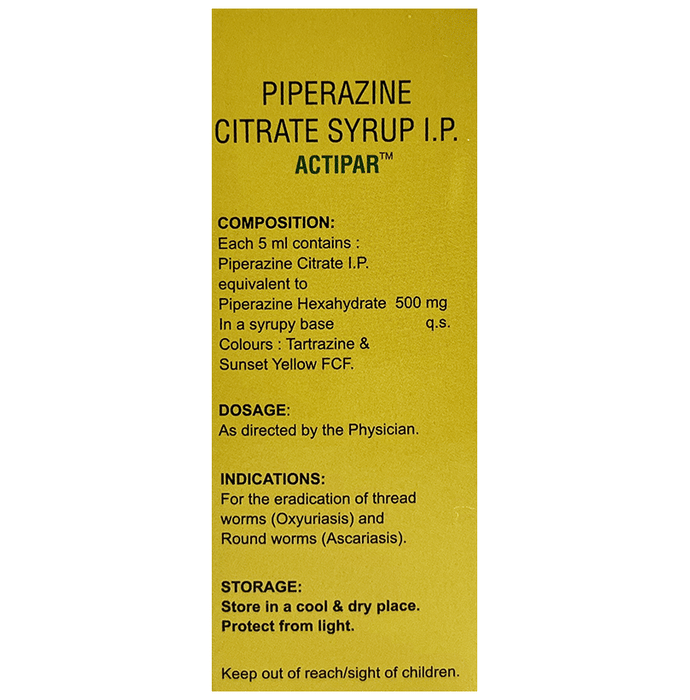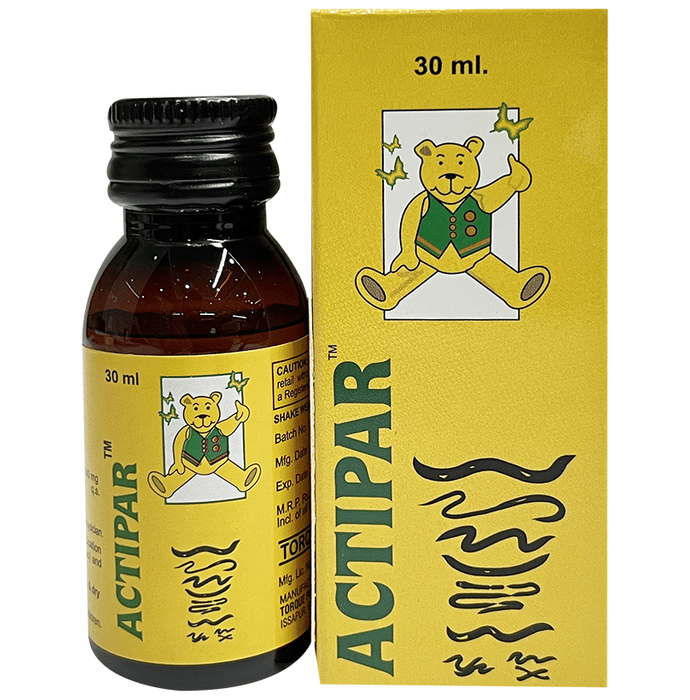
In Worm infections Actipar Syrup is a medicine that helps treat many parasitic worm infections. It works by killing and stopping the further growth of parasites causing the infection. This medicine usually makes you feel better quite quickly. However, you should continue taking it as long as it is prescribed even when you feel better, to make sure that all parasites are killed and do not become resistant.
Take this medicine in the dose and duration as advised by your doctor. Check the label for directions before use. Measure it with a measuring cup and take it by mouth. Shake well before use. Actipar Syrup may be taken with or without food.
- Alcohol : CAUTION
Alcohol should be used with caution while taking Actipar Syrup. | - Pregnancy : CONSULT YOUR DOCTOR
The safety of Actipar Syrup during pregnancy has not been established. There are no adequate and well-controlled studies in pregnant women, and animal data on reproductive toxicity are insufficient. Your doctor will weigh the benefits and any potential risks before prescribing. | - Breast feeding : CAUTION
Actipar Syrup should be used with caution during breastfeeding. Breastfeeding should be held until the treatment of the mother is completed and the drug is eliminated from the body. | - Driving : UNSAFE
Actipar Syrup may decrease alertness, affect your vision, or make you feel sleepy and dizzy. Do not drive if these symptoms occur. | - Kidney : UNSAFE
Actipar Syrup is unsafe to use in patients with kidney disease and should be avoided. | - Liver : CAUTION
Actipar Syrup should be used with caution in patients with liver disease. Dose adjustment may be needed.
If you miss a dose of Actipar Syrup, take it as soon as possible. However, if it is almost time for your next dose, skip the missed dose and go back to your regular schedule. Do not double the dose.\t\t
Piperazine belongs to class of drugs called anthelmintic. It works by paralyzing the worms and making them to pass in the stool.?It is effective against the intestinal nematodes roundworm (Ascaris lumbricoides), pinworm and threadworm (Enterobius vermicularis). Piperazine produces a neuromuscular block leads to muscle paralysis of the worms which are consequently dislodged and expelled in the faeces.
-Pyrantel Pamoate (Oral Route): Severe
Do not consume Pyrantel Pamoate with Piperazine. Piperazine may reduce the efficacy of Pyrantel Pamoate.
| -Chlorpromazine (Oral Route): Moderate
Caution is advised when taking Chlorpromazine with Piperazine as both medicines can cause convulsions. Concomitant use may increase the risk of convulsions.
| -Chlorpromazine (Injection Route): Moderate
Caution is advised when taking Chlorpromazine with Piperazine as both medicines can cause convulsions. Concomitant use may increase the risk of convulsions.