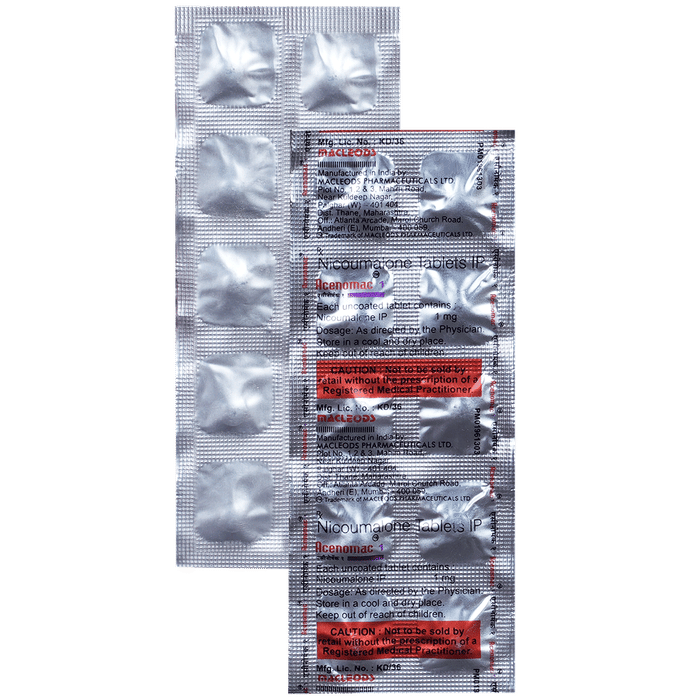
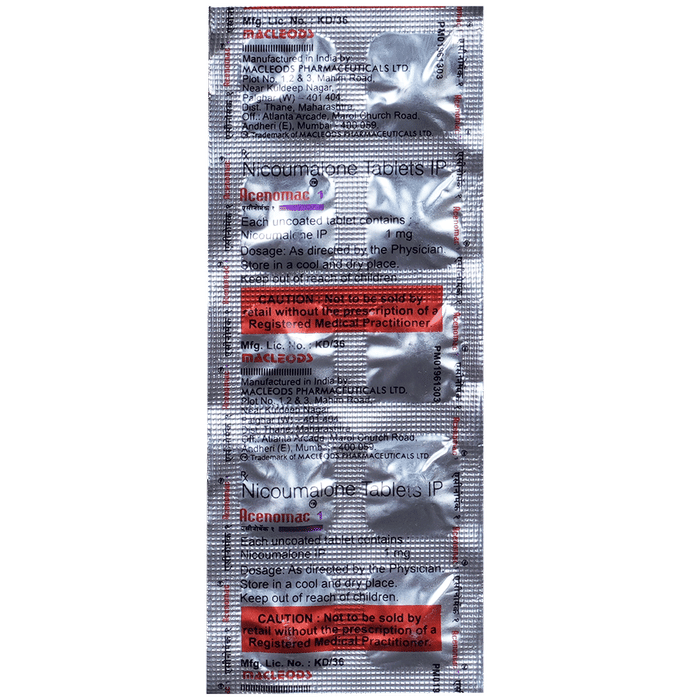
Take this medicine in the dose and duration as advised by your doctor. Swallow it as a whole. Do not chew, crush or break it. Acenomac 1 Tablet may be taken with or without food.
- Alcohol : CAUTION
Alcohol should be used with caution while taking Acenomac 1 Tablet. | - Pregnancy : UNSAFE
Acenomac 1 Tablet is highly unsafe during pregnancy. It can cause serious harm to the unborn baby, including birth defects and pregnancy loss. Do not use this medicine if you are pregnant or planning to become pregnant. | - Breast feeding : CONSULT YOUR DOCTOR
Acenomac 1 Tablet may be unsafe to use during breastfeeding. Limited human data suggests that the drug may pass into the breastmilk and harm the baby. It should be used only if the expected benefit outweighs the potential risk. Please consult your doctor. | - Driving : SAFE
Acenomac 1 Tablet does not usually affect your ability to drive. | - Kidney : CAUTION
Acenomac 1 Tablet should be used with caution in patients with kidney disease. Dose adjustment may be needed.Use of Acenomac 1 Tablet is not recommended in patients with severe kidney disease. | - Liver : CAUTION
Acenomac 1 Tablet should be used with caution in patients with liver disease. Dose adjustment may be needed.Use of Acenomac 1 Tablet is not recommended in patients with severe liver disease.
If you miss a dose of Acenomac 1 Tablet, take it as soon as possible. However, if it is almost time for your next dose, skip the missed dose and go back to your regular schedule. Do not double the dose.
How long do I need to take Acenomac 1 Tablet?::: You should continue taking Acenomac 1 Tablet for as long as recommended by your doctor. Depending upon the condition you are being treated for, you may have to take it for several months or years or maybe for the rest of your life.| What should I avoid while taking Acenomac 1 Tablet?::: You should avoid alcohol while taking Acenomac 1 Tablet as alcohol may interfere with working of Acenomac 1 Tablet. In addition to that, avoid cranberry juice or other cranberry products as there may be a risk of enhanced blood thinning. Avoid breastfeeding or getting pregnant as it may harm your child.| Do I need to stop Acenomac 1 Tablet if I have to undergo a surgery?::: Depending on the type of surgery that is to be performed, your doctor will tell you whether to continue or stop Acenomac 1 Tablet. It will be decided by your doctor after weighing the risks and benefits of discontinuing Acenomac 1 Tablet.| Is Acenomac 1 Tablet same as warfarin?::: Both Acenomac 1 Tablet and warfarin are blood thinners, but they have some differences. Warfarin has a more stable blood thinning effect.| How long does it take for Acenomac 1 Tablet to start working?::: It takes a little longer for Acenomac 1 Tablet to start working. On an average, it may take 2-3 days for Acenomac 1 Tablet to show its blood-thinning effect. For these 2-3 days, heparin may be used and then discontinued.| What if I forget to take a dose?::: If you forget to take a dose of Acenomac 1 Tablet, take it as soon as you remember. However, if it is time for your next dose then skip the missed dose. Do not double the dose and continue your normal schedule. Keep a diary or set a reminder, so that you do not forget it often.| What monitoring is required while taking Acenomac 1 Tablet?::: The bleeding times should be carefully monitored from 2nd or 3rd dose of Acenomac 1 Tablet and till the clotting status is stabilized. Thereafter, the bleeding time can be monitored monthly. This frequency may be more in elderly.
Acenomac 1 Tablet works by slowing down the body's ability to form blood clots. It does this by blocking the action of vitamin K, which is essential for making clotting proteins in the liver. By reducing these clotting proteins, Acenomac 1 Tablet thins the blood, making it less likely for harmful clots to form.
-Axitinib (Oral Route): Life-threatening
If concurrent use is essential, watch out for bleeding and consult your doctor immediately. Your doctor may frequently monitor your blood clotting time. Concurrent use may increase the risk of bleeding.
| -Phenytoin (Oral Route): Severe
If concurrent use is essential, your doctor may monitor your treatment and adjust the doses as per the observations. Concurrent use may increase the risk of severe bleeding.
| -Cabozantinib (Oral Route): Severe
If concurrent use is essential, watch out for bleeding and consult your doctor immediately. Your doctor may frequently monitor your blood clotting time. Concurrent use may increase the risk of bleeding.
| -Cilostazol (Oral Route): Severe
Do not consume Acenocoumarol with Cilostazol. If concurrent use is essential, watch out for bleeding and consult your doctor immediately. Concurrent use may increase the risk of bleeding.
| -Dasatinib (Oral Route): Severe
If concurrent use is essential, watch out for bleeding and consult your doctor immediately. Your doctor may frequently monitor your blood clotting time. Concurrent use may increase the risk of bleeding.